
An emergency luminaire that has never been tested is, for the purposes of an inspection, an emergency luminaire that does not work. The testing regime is not complicated, but the record is what gets checked.
Monthly: the function test
Simulate a mains failure long enough to confirm every luminaire strikes and every exit sign illuminates. Restore supply and confirm the charge indicator returns. The test is brief by design, so that batteries are not discharged unnecessarily.
Log the date, the result for each luminaire, and any unit that failed to strike or showed a fault indicator. A failed unit should be replaced or repaired before the next test cycle.
Annual: the full duration test
Once a year each luminaire has to run for its full rated duration, one, two or three hours depending on the specification. At the end of the period, the illuminance must still meet the design levels. Units that fade early have batteries at end of life.
Schedule the annual test when the building can tolerate a full recharge period afterwards. A LiFePO4 cell needs 10 to 12 hours to return to full charge; during that window the installation is not compliant.
Keeping the record
The log should identify each luminaire by location and reference, and record the date, the type of test, the result and the name of the person carrying it out. Keep it with the fire safety documentation for the building.
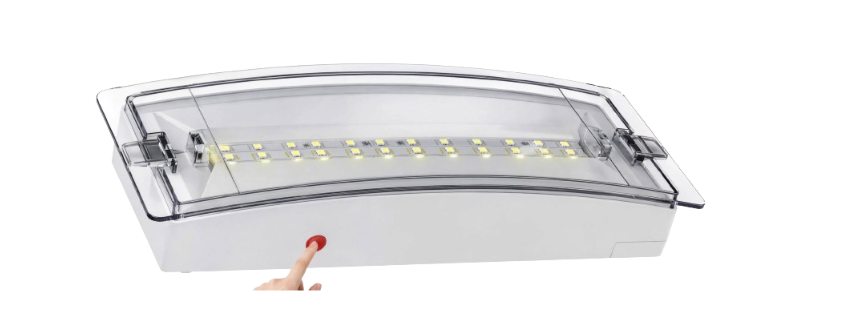
Models with an integrated test button, such as the PX-49015, let a single person run the monthly test from the luminaire itself without touching the distribution board, which is what makes a large installation practical to maintain.