
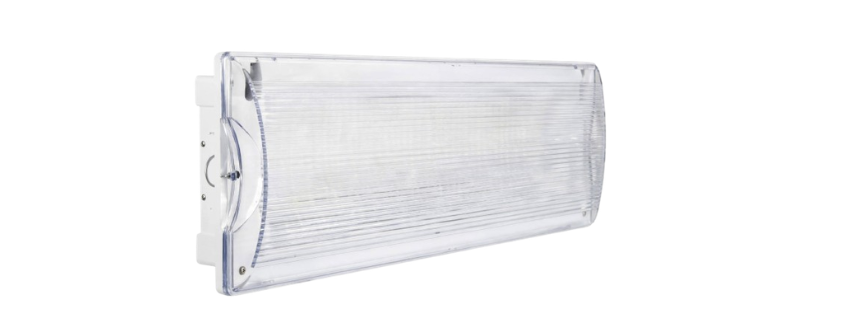
Every emergency luminaire is specified in one of two operating modes. The hardware is often identical; the difference is what the driver does while mains power is present.
Maintained
The LED is lit continuously, on mains during normal operation and on battery during a failure. Occupants see no changeover at all, which is why maintained units are the norm in spaces open to the public: cinemas, hotels, retail floors and assembly areas, where an instant of darkness would cause a hazard in itself.
The cost is running hours. A maintained unit accumulates LED hours continuously, and draws a small but constant load.
Non-maintained
The luminaire stays dark while mains is present and strikes only on failure. Consumption drops to the trickle charge current, and LED life is measured in test hours rather than calendar hours.
This suits spaces that are not continuously occupied and where a brief transition is acceptable: warehouses, plant rooms, back-of-house corridors and storage areas.
Combined units
Several Polaryx references, including the PX-49015, PX-49012 and PX-49312, can be wired either way, which is useful on mixed-use floors where a single reference simplifies stock and maintenance.
Deciding
Start from the occupancy of the space rather than from the product. If people who do not know the building are present, specify maintained. If the space is used by staff who know the escape route, non-maintained is usually sufficient and cheaper to run.