Replacing fluorescent emergency fittings with LED
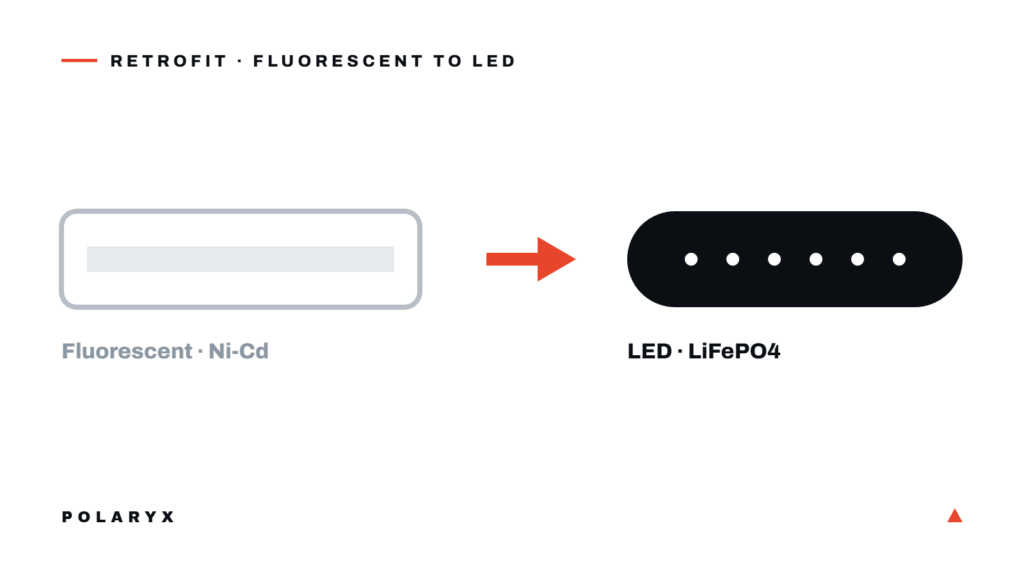
Many buildings still carry emergency fittings installed fifteen or twenty years ago: fluorescent tubes, magnetic or early electronic ballasts and nickel-cadmium battery packs. Replacing them is often driven by failed tests, but the gains go further than a pass.
What improves
LED sources draw a fraction of the power of a fluorescent tube for the same emergency output, which lets a smaller battery deliver a longer duration. There are no tubes to replace, and output does not collapse at low temperature the way fluorescent does.
Check the layout, not only the fitting
A one-for-one swap keeps the old spacing. LED luminaires have different light distributions, and the original layout may have been designed to an earlier edition of the standard. Recheck the points of emphasis and the route illuminance before ordering.
Wiring and mode
Confirm whether each position is wired maintained or non-maintained, and whether a switched live is present. Units that support both modes, such as the PX-49015, PX-49012 and PX-49312, reduce the risk of ordering the wrong variant.
End of life
Removed Ni-Cd packs are hazardous waste and must be returned through a battery collection scheme. Fluorescent tubes contain mercury and follow the WEEE route. Plan disposal into the job from the start.